

The technical components of the Telematics Infrastructure
The healthcare sector is becoming increasingly digital. However, the Telematics Infrastructure (TI) still cannot function entirely without hardware—although this will gradually change with the introduction of TI 2.0. Currently, the most important technical components for digital networking are card terminals and connectors. In addition, smartcards such as eHPC and ePC for healthcare providers, as well as SMC-B or SM-B for practices, pharmacies, hospitals and other institutions, are required.
Authentication made easy: the card terminals
eHealth card terminals fulfil various functions. Some are only used to read the electronic health cards (EHC) of insured persons. Most card terminals, however, also enable authorised healthcare providers to access applications of the Telematics Infrastructure such as the electronic patient record (ePA) or the electronic sick note (eAU -certificate of incapacity for work). Card readers are indispensable for accessing the specialised applications of the Telematics Infrastructure. They are used to read the relevant smartcards, which prove the authorisation of service providers and institutions.
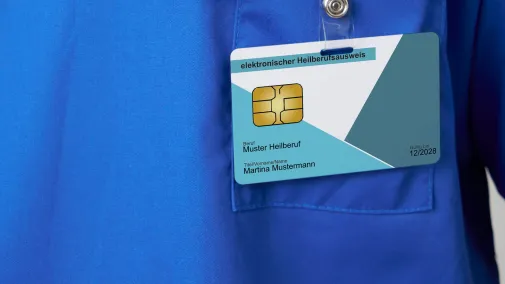
The smartcards SMC-B and SM-B are intended for institutions – i.e. medical practices, hospitals, rehabilitation and preventive care facilities, pharmacies, health insurance funds, and medical supply companies. Healthcare service providers must also authenticate themselves via the card terminals. For this purpose, they require an electronic health professional card (eHPC) or professional card.
Depending on the size of the institution, it should be considered how many stationary card terminals are actually needed as end devices. Alternatively, there are mobile card terminals, on which individuals must authenticate themselves with their eHPC and institutions with the SMC-B. However, such smartcards will soon become obsolete, as will mobile terminals: In TI 2.0, both individuals and institutions will receive digital identities, which they can use to identify and authenticate themselves to the telematics infrastructure.


Specialist applications of the telematics infrastructure, such as the electronic patient file, can only be used if both parties – individual and institution – have authenticated themselves via the card terminal. All of these smartcards can be ordered via the eHealth Application Portal from D-Trust, a subsidiary of Bundesdruckerei.

Encrypting information securely: the connectors
Connectors function similarly to routers, but with a significantly higher security level. In addition to approval by gematik (the National Digital Health Agency), each model also requires certification by the Federal Office for Information Security (BSI). For security reasons, the service life of the connectors is limited to five years, after which a connector replacement is required.
Connectors are linked to the stationary card terminals. In addition, there is a connection to the pharmacy, hospital, or practice management system (AVS, KIS, PVS) for secure transfer of patient information from the ePA (electronic patient file) into TI applications, such as the management of insured basic data (VSDM) or emergency data management (NFDM).
The data transmitted within the digitally networked healthcare sector is sensitive. No one may access it unless they are authorised to do so. Therefore, information such as electronic doctor’s letters (eArztbriefe) is exchanged via a Virtual Private Network (VPN), in which all health data is encrypted. This task is handled by the connectors.
Communication between all parties is encrypted using a cryptographic procedure developed by the Federal Office for Information Security (BSI). This multi-stage process is regularly updated in line with the latest technological developments to ensure it meets the highest security standards at all times. This guarantees data security.
Institutions that wish to operate without their own connector – for example medical practices or pharmacies – can also obtain TI access as a service from certified providers. These providers, known as TI gateway providers, are responsible for operations and data protection. The first TI gateway solutions have already been approved by gematik.
However, larger hospitals and comparable institutions will not be able to do without connectors for telematics for the time being. Nonetheless, soon each of these institutions will only need a single (high-speed) connector.
Connectors will become obsolete once the highly secure Zero Trust architecture is introduced as part of Telematics Infrastructure 2.0, which will raise data protection and data security to an even higher level.
Further information


Frequently Asked Questions about the Technical Components of the TI
Digitalisation is changing many processes in the healthcare sector. Naturally, this raises questions. Here we answer some of the most common questions regarding the technical components of the Telematics Infrastructure.
Currently, the TI consists of the following four components:
- A connector links healthcare providers within the Telematics Infrastructure, which is especially protected by a VPN (Virtual Private Network).
- The eHPC/ePC identifies the holder within the TI as a member of a specific professional group.
- Healthcare institutions must also authenticate themselves. This applies to medical practices, hospitals, rehabilitation and preventive care facilities, pharmacies, health insurance funds, and medical supply companies. You will need an institution card known as SMC-B or SM-B in the form of a smartcard. All of these smartcards can be ordered via the eHealth Application Portal operated by D-Trust, a subsidiary of Bundesdruckerei.
- eHealth card terminals recognise both eHBA and eBA, as well as SMC-B or SM-B. If authentication is successful, the card terminal connects to the connector, thereby enabling use of the Telematics Infrastructure. Depending on the model, the card terminals can also read the electronic health card (EHC) of insured persons.
Connectors perform important functions within the Telematics Infrastructure in healthcare: They ensure data security and data protection when exchanging information about insured persons. Technically, they are similar to conventional internet routers, but with a significantly higher level of security, as these connectors operate within a VPN (Virtual Private Network).
Connectors are connected to the card terminals required for authenticating employees and institutions. In addition, there is a connection to the hospital, pharmacy, hospital or practice management system (KIS, AVS, PVS).
Currently, this is not yet possible, but this will change with the introduction of digital identities in Telematics Infrastructure 2.0. In the future, medical professionals will be able to identify themselves using their smartphones instead of the electronic health professional ID card (eHPC). Institutions such as practices, care homes, hospitals and pharmacies will also receive digital identities. As a result, SMC-B and SM-B will become obsolete.
Institutions such as practices, clinics and pharmacies can also obtain access to the Telematics Infrastructure (TI) through renting it as a service. These providers, known as TI gateway providers, are responsible for operations and data protection. As the National Agency for Digital Medicine, gematik has already approved the first TI gateway solutions.