

Telematics Infrastructure – For a Digital Healthcare System
Healthcare is becoming more digital: all participants are connected with each other through the telematics infrastructure. This allows for faster data exchange, comprehensive medical histories, and more accurate diagnoses. In addition, the telematics infrastructure (TI) enables forward-looking innovations such as integrating telemedicine into everyday practice.
How exactly does the telematics infrastructure work?
The telematics infrastructure connects all parties involved in medical care. Information is exchanged online without the loss of time or data. Only authorised healthcare providers can access it, and they must have authenticated themselves. They operate within a closed system, where medical information is exchanged much like traffic on a data highway.
- Digital doctors’ letters can be exchanged and e-prescriptions can be issued.
- Collaboration between all parties becomes more efficient.
- Data protection and security are given the highest priority.
Telematics infrastructure: Applications and Areas of Use
At the centre: The Electronic Patient File (ePA)
All relevant medical data of patients is centrally stored in the electronic patient file (ePA). An ePA is automatically created for all persons with statutory health insurance – unless they actively opt-out. Privately insured individuals can request the creation of an electronic patient file through their insurance provider. Medical staff can, with patient consent, access health data such as medical letters, test results or medication information via the ePA if required.
Go to TI Applications


Your access in four steps
In order to use the telematics infrastructure (TI) in healthcare, various components must be connected to each other.
- A connector establishes a secure VPN connection between the participantsand is linked to a card terminal.
- To authenticate and access the telematics infrastructure, every facility – whether a practice, hospital, care home, pharmacy or other – requires the SMC-B practice or institution card, or its digital variant HSM-B. This makes the digital exchange of medical information straightforward.
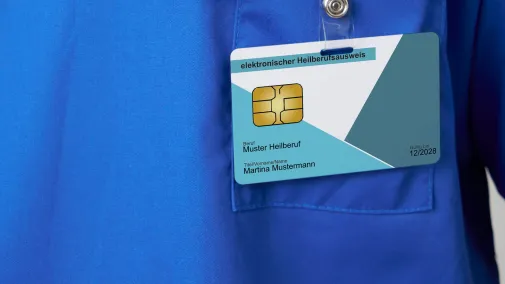
- In addition, healthcare staff need a personalised electronic health professional ID card (eHBA) or professional ID card (eBA) in order to authenticate themselves.
- With the eHBA/eBA, authorised healthcare staff can digitally sign TI applications such as e-prescription (E-Rezept), the electronic certificate of incapacity for work (eAU), or entries in the ePA.
The ID cards: Who Needs Which?
Only authorised persons may use the telematics infrastructure. To do so, both healthcare institutions and their employees must authenticate themselves. You will find the right product for your needs at D-Trust, a subsidiary of the Bundesdruckerei Group


How to Use the Telematics Infrastructure

The telematics infrastructure connects all healthcare providers, however not all health data is accessible to everyone. Different professional groups and institutions have different regulations governing their access to patient data. Patients no longer need to give separate consent for each individual access to their electronic patient file (ePA). In the context of treatment, healthcare institutions can access data for those with statutory health insurance even without explicit consent,as long as the patient has not objected (opted-out). On the D-Trust website, a subsidiary of the Bundesdruckerei Group, you can find detailed information on how to make optimal use of telematics infrastructure features in your professional field.










Other Relevant Products for Digital Healthcare


Data Protection and Security in the Telematics Infrastructure
Patient data is highly sensitive. Protecting it appropriately is not only a given but also essential for the success and acceptance of the telematics infrastructure in the healthcare sector. The standards for data protection and security for all health data are continuously enhanced and regularly updated.
Further information



Frequently Asked Questions About the Telematics Infrastructure
Digitalisation is changing many processes in healthcare. Naturally, this raises questions. Below we answer some of the most frequently asked questions about the telematics infrastructure in healthcare.
Access to the telematics infrastructure, as a closed network, is highly secured to prevent unauthorised access. Anyone working in healthcare who wishes to order an SMC-B card for their organisation or sign documents electronically requires an electronic health professional card (eHBA) or a professional card (eBA). Relevant organisations such as hospitals, care homes, pharmacies or practices require the practice or institution card SMC-B, or in future, its digital alternative, the HSM-B (institution certificates – Hardware Security Module, type B). These smartcards or digital identities must be applied for and activated before they can be used. Additionally, hardware or software-as-a-service components are required, which can be obtained via your IT service provider.
To use the telematics infrastructure, the TI 1.0 setup requires a card terminal and connector, as well as the smartcards for authentication. Healthcare professionals and institutions can apply for the required ID cards through their respective card issuers.Then, they must order the eHBA/eBA or the SMC-B via the eHealth application portal of D-Trust, a subsidiary of Bundesdruckerei Group.
Delivery can take several weeks from point of order.Three days after your ID card is dispatched, D-Trust sends the PIN for activation in a separate letter.
The application process consists of several steps. In certain sectors, an electronic healthcare professional ID (eHBA) card number is required in order to apply for an institution card (SMC-B)The practice or institution card authorises the healthcare organisation as a participant within the telematics infrastructure.
Within the TI, various health and treatment data can be exchanged. For example doctors’ letters, medication plans, results of imaging procedures, or e-prescriptions.. Data security is ensured by end-to-end encryption. Only users authenticated via eHBA/eBA or SMC-B have access to the data. Within the TI, the KIM service (Communication in Medicine) provides a directory service listing all authorised and connected practices and institutions that can exchange KIM messages. KIM operates like a secure email system, enabling all necessary data to be exchanged securely, including, for example, billing data as well as the eAU (electronic certificate of incapacity for work).
Protecting sensitive medical data is a fundamental aim of the telematics infrastructure. The TI is therefore designed for maximum availability with the highest level of security. It is a closed network that can only be accessed via a connector by users who have been properly authenticated. It also operates separately from the public internet. This is made possible by a VPN (a virtual private network) which is built in accordance with the requirements of the Federal Office for Information Security (BSI) and is approved by gematik (National Digital Health Agency).
All data exchanges between participants in the TI are encrypted using multi-layer cryptographic methods, which areregularly updated to meet the highest current security standards at all times.
The telematics infrastructure in healthcare always aims to balance data security and ease of use. While data protection and security take top priority, the TI is also designed to be as user-friendly as possible for all participants. For this reason, user experience also plays a central role in the ongoing development of the TI. To better understand user experience, regular feedback is collected from all participants and, since no product is perfect, gematik (National Digital Health Agency) conducts an annual comprehensive evaluation of the TI’s processes, products, and security. This evaluation helps to identify potential vulnerabilities so that they can be addressed and improved.