Language:

Dentist and medical practices

Electronic doctor/dentist card (eHBA) and SMC-B Practice Card

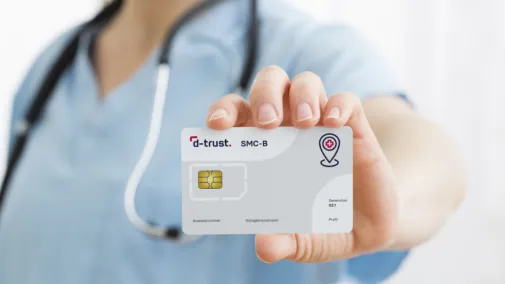
The electronic Health Professional Card (eHBA) for doctors and dentists – often referred to as the electronic doctor card or electronic dentist card – serves as the personal access card to the telematics infrastructure (TI). The TI is a digital network connecting all stakeholders within the healthcare system. Access to information within this system is strictly regulated. Medical practices connect to the TI using the electronic SMC-B Practice Card.

Functions: What are the eHBA and SMC-B used for?

The electronic Health Professional Card (eHBA) performs several functions as a personalised smart card. It enables doctors and dentists to authenticate themselves for applications within the telematics infrastructure (TI), i.e. to verify their identity digitally. Because the eHBA also enables the use of qualified electronic signatures, the card can be used within the telematics infrastructure to digitally sign documents such as electronic prescriptions, laboratory referrals, electronic certificates of incapacity for work (eAU), medical reports and EBZ messages (electronic application and approval procedures). In addition, medical data can be encrypted when sent and decrypted by the recipient. Finally, the electronic doctor or dentist card also serves as a visual identification card, as it contains the holder’s photograph.

Using the SMC-B Practice Card, healthcare organisations authenticate themselves to the services of the telematics infrastructure as medical institutions. The card enables a practice to access patient information stored in the electronic patient record (ePA) and to communicate securely within the TI.

In addition to the eHBA and SMC-B, connecting to the telematics infrastructure also requires several hardware-based technical components such as eHealth card terminals and connectors. 

Today, the eHBA and SMC-B are standard in medical and dental practices. Since 2021, the use of the telematics infrastructure has been mandatory for doctors and dentists. From that point onwards, practices have also been required to populate a patient’s electronic patient record at the patient’s request. In this way, the eHBA and SMC-B are helping to drive the digital transformation of healthcare: electronic processes are replacing paper-based workflows.


The Benefits of the Telematics Infrastructure

Whether prescriptions, referrals or medical reports: many processes are faster in digital form. Documents no longer need to be sent by fax, and outstanding questions can be resolved quickly through the applications of the telematics infrastructure.

  • Less administrative effort means more time for patients
  • All relevant patient information is available in an up-to-date form at all times
  • Access to digital services such as the electronic patient record (ePA), electronic medication plan (eMP) and e-prescription
  • Improved communication: authorised healthcare providers use TI Messenger and KIM for fast and secure communication between professionals and institutions
  • Digital processes and technologies increase efficiency by replacing analogue workflows
  • Emergency data management and the electronic medication plan improve treatment safety
  • The highest standards of data transmission and storage enhance the security of data exchange
  • Legally binding digital signatures are possible

These TI applications are used by doctors and dentists

Pictogram Person Circle

The ID card for individuals

eHBA (electronic health professional card) and ePA (electronic professional card)

The eHBA is used by members of the healthcare professions to identify themselves within the telematics infrastructure. Authorised tradespeople working in health-related trades can use the electronic professional card (eBA) for this purpose. You can find out how to apply for an eHBA or eBA in this step-by-step guide.


Examples of eHBA applications:

  • Write access to TI applications
  • Qualified electronic signature (QES), e.g. for e-prescriptions
  • Encrypted data exchange
  • Access to the electronic patient record
Pictogram ID card with tick

The ID cards for Practices and Institutions

SMC-B: The Practice and Institution Card

Participating medical practices and other institutions, such as hospitals, rehabilitation and care facilities, pharmacies, and medical and assistive technology suppliers, use the SMC-B to authenticate themselves to the telematics infrastructure.


Examples of SMC-B applications:

  • Secure access to the telematics infrastructure
  • Access to patient information within the TI
  • Encryption of communications in the healthcare sector (KIM) within the TI
Pictogram hands

Example Use Case: A New Patient Visits the Practice

In the past, when a patient changed practices, the entire medical history had to be reconstructed through lengthy consultations and then documented – with the risk that important information about the patient’s medical history or current health status might be overlooked. With the eHBA and SMC-B and access to TI applications, documenting and exchanging patient data is made easier.

  • VSDM – insurance master data management: the insured person’s details on the electronic health card are checked online and updated if necessary, confirming that the patient is entitled to receive services.
  • ePA: The electronic patient record provides insights into their medical history and previous treatments. Although the record is managed by the patient and does not replace a medical history consultation, authorised healthcare providers can access certain treatment documents.
  • KIM and TI Messenger: missing documents can be requested via the KIM email service or the TI Messenger direct messaging service. Questions or corrections regarding medication can also be quickly clarified with other healthcare providers, such as pharmacies.
  • eMP: the electronic medication plan compiles key information on the medications currently being taken and other medication-related details that help avoid interactions such as allergies.
Pictogram health

Example Use Case: Sharing Patient Data

Prescriptions, medical reports and medical orders can be exchanged digitally via the telematics infrastructure (TI). Practice staff gain access to relevant medical information through the electronic patient record (ePA) and can communicate with other healthcare providers via KIM (Communication in Healthcare) and the TI Messenger (TIM).

  • ePA: The electronic patient record provides insights into the patient’s medical history and treatment pathway – including information from other healthcare providers who previously treated the patient or who may still be involved in their care.
  • eMP: Information on the patient’s current medication helps prevent adverse drug interactions.
  • TIM: The TI Messenger enables quick communication with specialists or pharmacies when required.
  • KIM: Test results, medical reports and other documents can be exchanged securely via email between relevant parties, such as specialists, general practitioners or hospitals.

Funding and reimbursement for connecting to the TI

To use the telematics infrastructure (TI), practices must first make certain investments. At a minimum, a card terminal and a connector for authentication within the VPN-secured TI network are required. Additional costs include the electronic doctor card (eHBA) and the SMC-B Practice Card or SM-B, as well as for TI-compatible software.

Connection to the telematics infrastructure is reimbursed through TI flat-rate payments, which are paid out monthly. The amount varies depending on the size of the practice. These payments are provided by the National Association of Statutory Health Insurance Funds GKV-Spitzenverband (german). Further information on funding is available on their website.

Generation 2.0: Card Replacement Required

Please note that Generation 2.0 cards will no longer be usable for qualified electronic signatures from 1 July 2026 at the latest. Please ensure that replacement cards are ordered in good time. Further information is available on our support page under “Replacement programme for Generation G 2.0 eHBA

Frequently Asked Questions About the Electronic Doctor Card and Electronic Dentist Card (eHBA)

As digitalisation continues to transform healthcare, many processes are changing. Naturally, this raises questions. Below we answer some of the most frequently asked questions about the electronic doctor card and electronic dentist card.

No. Some medical chambers issue a physical doctor’s ID card, which simply confirms membership of the medical chamber. It is often used at professional training events, where it can be scanned instead of using labels with training numbers. The electronic Health Professional Card (eHBA) – sometimes also referred to as an electronic doctor card – is used for authentication, encryption and electronic signatures within the telematics infrastructure. To avoid confusion, we therefore generally refer to it as the eHBA rather than an “electronic doctor card”.

To use the telematics infrastructure (TI), two cards are required, along with a card terminal and a connector. The first card is the electronic doctor card or electronic dentist card (officially the electronic Health Professional Card, eHBA) for doctors and dentists. The SMC-B Practice Card is also required for a medical or dental practice to authenticate itself to the telematics infrastructure. Using the SMC-B, practice staff can access the TI with read permissions. Both cards are read via the card terminal. Through a connector linking the card terminal with the practice system, data are exchanged securely via a private VPN network.

Yes. With D-Trust, doctors and dentists can order their eHBA entirely online. With the e-application, there is no need to print, sign and send the application – everything is done online. Using the eID function of your ID card or passport, you can also complete identification online. Alternatively, identification via the PostIdent procedure at a Post Office branch is possible. Applications can be submitted through the D-Trust eHealth application portal (german).

Only one SMC-B is required per practice location, regardless of how many stationary card terminals are used. However, each mobile card reader requires its own SMC-B.

Using the telematics infrastructure requires certain hardware, including at least one card terminal and a connector for authentication within the VPN-secured TI network. These devices are tested and approved by gematik, the National Agency for Digital Medicine. Additional costs include the electronic Health Professional Card (eHBA) the SMC-B Practice Card, and TI-compatible software. Connection to the TI is reimbursed through the GKV-Spitzenverband (german). Further information on funding is available on their website.

The electronic doctor card and electronic dentist card (eHBA) as well as the SMC-B Practice Card are valid for a maximum of five years. Replacement cards must therefore be applied for in good time. D-Trust informs users before the cards expire.

The electronic doctor card, like the electronic dentist card (eHBA), is valid for a maximum of five years and cannot be extended. A new card must therefore be applied for before the current card expires. Once expired, the card can no longer be used for any TI functions requiring an eHBA. Doctors and dentists receive an email from D-Trust in advance containing a link to order a replacement card. The application form is pre-filled using the data from the current eHBA. Users simply need to check that their information is up to date, submit the application and complete the identification process. As a rule, the new card is produced and dispatched within two weeks of application and identification. The PIN and PUK follow separately by registered post a few days later.

D-Trust sends several reminders before the expiry date to ensure that replacement cards are ordered in good time. The same applies to the SMC-B Practice Card, which is also valid for a maximum of five years.

Related Products

Costs for the electronic doctor card/electronic dentist card (eHBA)

Product description
Price in EUR*

eHBA

for doctors and dentists
420,17 €
  • enables all doctors, dentists and psychotherapists to authenticate themselves with the healthcare telematics infrastructure. The cost of medical ID cards is partially covered by the flat-rate operating cost under the funding agreement.
  • valid for 5 years

* Prices in euros (€), plus statutory VAT.

Product description
Price in EUR*

SMC-B

for doctors and dentists
390,76 €
  • The cost of the practice licence is partially covered by the flat-rate operating allowance under the funding agreement.
  • Valid for 5 years

* Prices in euros (€), plus statutory VAT.

You may also be interested in

Do you have any questions about our e-health products? Please contact us:

+49 (0)30 2598 - 4050