
Language:

Women Conversation Advice

Electronic Psychotherapist Card (eHPC) and SMC-B Practice Card

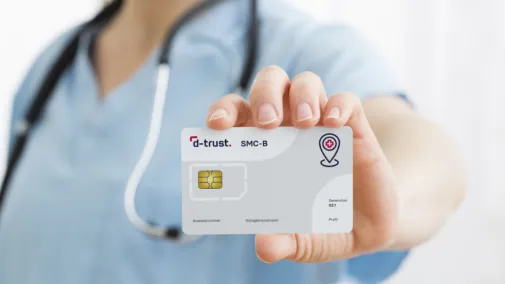
The electronic Health Professional Card (eHPC) for psychotherapists, also known as the electronic psychotherapist card (ePtA), is your personal access card to the telematics infrastructure. The TI is a digital network connecting all stakeholders across the healthcare system. Access to information within this system is strictly regulated. Healthcare practices connect to the TI via the electronic SMC-B Practice Card.

The benefits of the telematics infrastructure

Be it prescriptions, referrals or medical letters: digital processes make many tasks faster and more efficient. Faxing is no longer required, and queries can be resolved quickly using TI applications. 

  • Reduced administrative workload means more time for patients 
  • All relevant patient information is available and up-to-date at all times 
  • Access to digital applications such as the electronic patient record (ePA) 
  • KIM and the TI Messenger enable fast and reliable communication between staff and organisations 
  • Digital workflows improve efficiency compared to paper-based processes 
  • Emergency data management and electronic medication plans enhance treatment safety
  • High standards for data transmission and storage ensure secure data exchange 
  • Legally valid electronic signatures are possible

TI applications for psychotherapists

eHPC or SMC-B – what is each card used for?

With the SMC-B, psychotherapy practices authenticate themselves to the telematics infrastructure. Psychotherapists require the eHBA for personal access to the TI, for authentication, as proof of their professional status and for digital signatures. In addition to the eHBA and SMC-B, connection to the telematics infrastructure requires various hardware-based technical components, such as eHealth card terminals and connectors.

Pictogram Person Circle

For psychotherapists

The electronic Health Professional Card (eHPC)

The eHPC allows psychotherapists to verify their identity digitally. This personal card gives them access to TI applications. As the electronic psychotherapist card also enables digital signatures, documents can be signed digitally within the telematics infrastructure. Medical data can be sent in encrypted form and decrypted by the recipient. The eHPC also serves as a photo ID, as it includes a photograph.

Pictogram ID card with tick

For psychotherapy practices

The SMC-B Practice Card

The SMC-B Practice Card, or its virtual variant, the SM-B, is used by psychotherapy practices to authenticate themselves to the telematics infrastructure. The SMC-B gives practice staff access to the telematics infrastructure, although only with read permissions. Each practice requires at least one SMC-B in order to connect to the TI and use TI applications, such as encrypted communication.

How the telematics infrastructure works in psychotherapy practices

The Telematics Infrastructure supports psychotherapists in their day-to-day work. Using the electronic psychotherapist card or electronic Health Professional Card (eHBA), they can, for example, access the electronic patient record and sign documents digitally. With the SMC-B Practice card and the eHBA, access to the electronic patient record is possible provided that the patient has not opted out. KIM: Communication in Healthcare enables the secure digital exchange of documents with other healthcare providers or health insurance providers.

Pictogram hands

Example: a new patient visits the practice

In the past, when a patient moved to a new practice, the entire medical history had to be taken again and then documented, with the risk that important information about the patient’s medical history and/or current state of health might be forgotten. With the psychotherapist card, SMC-B and access to TI applications, the documentation and exchange of patient data become easier. 

  • VSDM: Insurance data on the electronic health card is checked online and updated where necessary through insurance master data management. This confirms that the patient is in fact entitled to receive services. 
  • ePA: The electronic patient record provides insights into the patient’s medical history and previous treatments. Although the record is managed by the patient and does not replace a medical history consultation, authorised healthcare providers can access certain treatment documents. 
  • KIM and TIM: Missing documents can be requested via the KIM email service or the TIM instant messaging service. Queries can also be clarified quickly with other healthcare providers.

Funding and financing your TI connection

Anyone wishing to use the telematics infrastructure (TI), must first make certain investments. At least one card terminal and a connector are required for authentication within the VPN-secured TI network. There are also acquisition costs for the electronic Health Professional card (eHBA), the practice card and TI-enabled software. 

Connection to the telematics infrastructure is largely refinanced through what are known as TI allowances, which are paid monthly. The amount varies depending on the size of the practice. These TI allowances are paid by the National Association of Statutory Health Insurance Funds GKV-Spitzenverband). Information on funding agreements is available on their website.

Prices for the electronic Health Professional Card (eHBA)

eHPC for doctors, dentists and psychotherapists
Price in EUR*

eHPC

The card for doctors, dentists and psychotherapists
420,17 €
  • Enables all doctors, dentists and psychotherapists to authenticate themselves with the healthcare telematics infrastructure; the cost of medical ID cards is partially covered by the flat-rate operating cost under the funding agreement 
  • Valid for five years

* Prices in euros (€), plus statutory VAT.

Price and product overview for the SMC-B

SMC-B for doctors, dentists and psychotherapists
Price in EUR*

SMC-B

The practice card for doctors, dentists and psychotherapists
390,76 €
  • The cost of the practice licence is partially covered by the flat-rate operating costs under the funding agreement
  • Valid for five years

* Prices in euros (€), plus statutory VAT.

Generation 2.0: card replacement required

Please note that Generation 2.0 cards will no longer be valid for qualified electronic signatures from 1 July 2026 at the latest. Please order a replacement in good time. Answers to all related questions can be found on our support page under “Replacement campaign for Generation G 2.0 eHPC cards”.

Psychotherapist's licence

Unlocking and activating the psychotherapist card (eHPC)

The electronic psychotherapist card (eHPC) is applied for via the relevant State Chamber of Psychotherapists, which issues a transaction number. This number can then be used to start the application process in D-Trust’s eHealth application portal and to order the card. The card is then produced and dispatched. It is unlocked in the application portal under “View my saved applications”. This also serves as confirmation that the card has been received. 

A card terminal is required for subsequent activation, along with the five-digit PIN from the PIN/PUK letter. For security reasons, D-Trust sends this letter by post separately from the eHBA, usually around three days later.

Frequently asked questions about the electronic psychotherapist card

As digitalisation continues to transform healthcare, many processes are changing. Naturally, questions arise. Here, we answer some of the most common questions about the Electronic Health Professional Card and the psychotherapist ID card.

To use the telematics infrastructure (TI), two cards are required, along with a card terminal and a connector. An electronic Health Professional Card (eHPC) is needed for an authorised representative, and an SMC-B Practice Card (or, in future, its digital version, SM-B) is required for authentication to the telematics infrastructure. Both cards are read via a card terminal. A connector is then used to access the telematics infrastructure. The eHBA must first be applied for through the relevant State Chamber of Psychotherapists.

Yes. With D-Trust, psychotherapists can order their eHPC entirely online. With the electronic application, there is no need to print, sign and send the order by post – the entire process can be completed online. You can also complete identification online using the eID function of your identity card or passport. Alternatively, identification can be carried out using PostIdent at a post office branch. 

You can submit your electronic application in D-Trust’s eHealth application portal.

Only one SMC-B is required per practice location, regardless of how many stationary card terminals are in use. However, a separate SMC-B must be applied for for each mobile card reader.

The electronic Health Professional Card (eHBA) for psychotherapists, like the SMC-B Practice Card, is valid for a maximum of five years. The cards cannot be renewed, so replacement cards must be applied for in advance. Psychotherapists receive a link by email from D-Trust in good time before expiry so that they can order a replacement card. The application is prefilled based on the information on the current eHBA. D-Trust customers only need to check that their details are up to date, submit the application and complete identification. As a rule, the new electronic Health Professional Card is produced and dispatched within a maximum of two weeks of the application being submitted and identification being completed. The PIN/PUK is then sent separately by registered post around three days later. 

D-Trust sends several reminders before the expiry date to ensure that replacement cards can be ordered in good time. The same applies to the SMC-B Practice Card.

Products

Costs for the electronic psychotherapist card (ePtA/eHPC) and the SMC-B

Price in EUR*

eHPC

for psychotherapists
420,17 €
  • Enables all doctors, dentists and psychotherapists to authenticate themselves with the healthcare telematics infrastructure; the cost of medical ID cards is partially covered by the flat-rate operating cost allowance under the funding agreement 
  • Valid for five years

* Prices in euros (€), plus statutory VAT.

Price in EUR*

SMC-B

for psychotherapy practices
390,76 €
  • The cost of the practice ID card is partially covered by the flat-rate operating costs under the funding agreement 
  • Valid for five years

* Prices in euros (€), plus statutory VAT.

Communication
Contact us

+49 (0)30 25 98 - 0

Das könnte Sie auch interessieren

Article
Article
Article
Article